




Showing posts with label When Friends/Family/Church People/Therapists Don't Understand Child-Loss Grief. Show all posts

Sunday, September 30, 2012

Saturday's Sayings - The Presence of An Absence


Saturday's Sayings

The Presence of An Absence


I have found in the years that have passed that I am most vulnerable at times of  remembrance. The word "anniversary" no longer holds a promise of celebration. Instead, holidays and birthdays, family gatherings, and otherwise joyous occasions contain an undertow of sorrow. If I get caught up in it, I quickly get pulled under and wind up gasping for breath. It is ironic that the presence of an absence can be so emotionally devastating.

~Bill Jenkins

This quote seems so very true for those of us who are bereaved parents, siblings, and grandparents. Do you find yourself particularly connected with the final sentence?
~The Compassionate Friends/USA


~~~~~


~Photo, thanks to "Grieving Mothers," B. J. Karrer


We feel like screaming, 
pulling our hair out, 
punching our pillow, or 
throwing dishes against the wall. 
Sometimes we're too weak to cry, 
so we make muffled sounds that don't even seem human. 
Other times we walk around like a zombie that hasn't slept for weeks on end. 
No, we're not crazy. 
We are a parent whose child has died, 
and we have lost all sense of purpose 
and no longer do we know how to live life. 
Don't pull away from us like we're a freak in a circus. 
Please stand by our side and simply be there. 
God knows, we just need somebody to stick by our side through this horrible thing called child loss.

~via Grieving Mother, Jill Compton


~~~~~
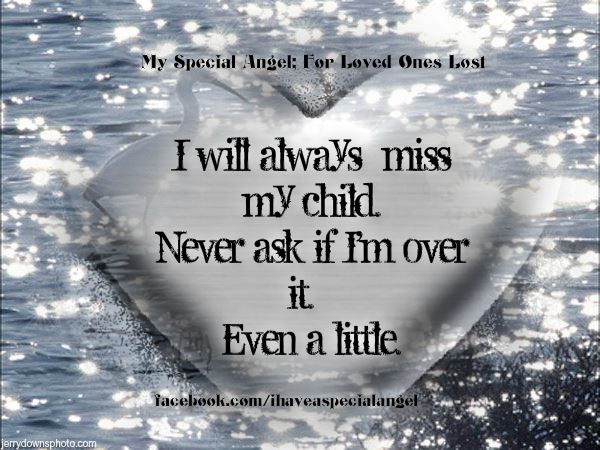


~Photo, by My Special Angel


Do you see me?
Hello, do you see me?
When you look at me, 
what do you see?
Do you only see the strong confident woman that I have always presented?
Does anyone see my grief?
Can anyone see how I am barely coping?
How can you not see the pain in my face?
Have you missed the tears in my eyes?
Do you only see the smile facade and fail to see that it is superficial?
Did you realize how hard it was for me to reach out and ask for help?
When you did follow through and help,
Can you not see that I don't have the strength to ask again?
Is anyone aware of how hard it is to go on and actually "live" life?
Do you know what a struggle it has been to accept that life goes on?
Do you know how it hurts to see his friends move on,
attend weddings,
get new jobs,
marry,
have kids?
Do you know how hard it was to go vacation without him?
Did you think I would post anything but the so called "happy" pictures on Facebook?
I am grieving,
tired,
exhausted,
sad,
worried and 
anxious.
But,
I AM ALSO STRONG.
I WILL SURVIVE.
Do you see me?

~By Mardi Slagle Peaster

via Grieving Mother, Jill Compton


~~~~~


~Photo via Wings of Hope~Living Forward


WHAT WE WISH OTHERS UNDERSTOOD ABOUT THE LOSS OF OUR CHILD

~By: Betty Baggott, Alabama Baptist BOD


· I wish you would not be afraid to speak my child’s name. My child lived and was important, and I need to hear his name.

· If I cry or get emotional if we talk about my child, I wish you knew that it isn’t because you have hurt me; the fact that my child died has caused me tears. You have allowed me to cry, and I thank you. Crying and emotional outbursts are healing.

· I wish you wouldn’t “kill” my child again by removing from your home his pictures, artwork, or other remembrances.

· I will have emotional highs and lows, ups and downs. I wish you wouldn’t think that if I have a good day my grief is all over, or that if I have a bad day I need psychiatric counseling.

· I wish you knew that the death of a child is different from other losses and must be viewed separately. It is the ultimate tragedy, and I wish you wouldn’t compare it to your loss of a parent, a spouse, or a pet.

· Being a bereaved parent is not contagious, so I wish you wouldn’t shy away from me.

· I wish you knew that all of the “crazy” grief reactions that I am having are in fact very normal. Depression, anger, frustration, hopelessness, and the questioning of values and beliefs are to be expected following the death of a child.

· I wish you wouldn’t expect my grief to be over in six months. The first few years are going to be exceedingly traumatic for us. As with alcoholics, I will never be “cured” or a “former bereaved parent,” but will forevermore be a “recovering bereaved parent.”

· I wish you understood the physical reactions to grief. I may gain weight or lose weight, sleep all the time or not at all, develop a host of illnesses, and be accident prone – all of which may be related to my grief.

· Our child’s birthday, the anniversary of his death, and holidays are terrible times for us. I wish you could tell us that you are thinking about our child on these days, and if we get quiet and withdraw, just know that we are thinking about our child and don’t try to coerce us into being cheerful.

· It is normal and good that most of us re-examine our faith, values, and beliefs after losing a child. We will question things we have been taught all our lives and hopefully come to some new understanding with our God. I wish you would let me tangle with my religion without making me feel guilty.

· I wish you wouldn’t offer me drinks or drugs. These are just temporary crutches and the only way I can get through this grief is to experience it. I have to hurt before I can heal.

· I wish you understood that grief changes people. I am not the same person I was before my child died, and I never will be that person again. If you keep waiting for me to “get back to my old self,” you will stay frustrated. I am a new creature with new thoughts, dreams, aspirations, values, and beliefs. Please try to get to know the new me – maybe you’ll like me still.

I believe that instead of sitting around and waiting for our wishes to come true, we have an obligation to tell people some of the things we have learned about our grief. We can teach these lessons with great kindness, believing that people have good intentions and want to do what is right, but just don’t know what to do with us.

~via Wings of Hope-Living Forward


~~~~~


Be Kind To Yourself; 
"Healing Is Baby Steps"


~Photo, thanks to "Grief The Unspoken"


Any parent who has been tossed onto the rough road of child loss is a hero simply for opening your eyes in the morning. Beyond that, all else you do is miraculous. When a large chunk of your heart has been suddenly yanked from your body, it's a daily struggle to walk, talk, think, focus, and do even the simplest of tasks. Yet, you're doing it! God bless every parent of child loss!

~Silent Grief, Child-Loss Support


~~~~~
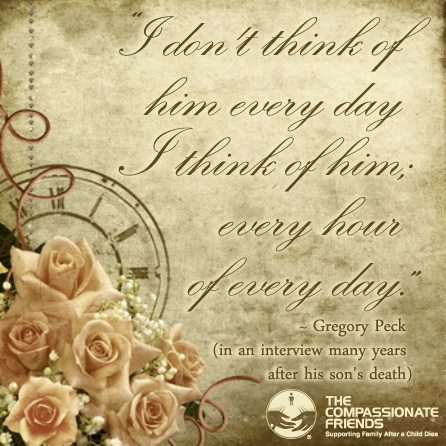


~The Compassionate Friends

Many years after his son died, the great actor Gregory Peck responded perfectly in an interview when asked if he thinks of his son every day.

"I don't think of him every day ~ I think of him: every hour of every day."

~Gregory Peck (in an interview many years after his son's death)


~~~~~


I've lived through things I would never 
have thought I was capable of, 
and I'm much less afraid than I used to be. 
The process of wounding awakens us to our strength. . . 
It shuffles our values, and the top priority 
is never what you thought it would be. 
It's never about perfection or power. 
It always turns out to be about LOVE. 
Knowing ourselves to be vulnerable 
and our time here to be limited, we're 
freed to live more passionately and fully… 
than we have before, to discover 
what's worth fighting for and who 
we are… real strength lies buried at the 
depths of any wound we have SURVIVED.


~via Acts of Simple Kindness, Inc.


~~~~~


"Remember that grief is as personal
as a fingerprint. Don't tell me how I 
should or shouldn't be doing it or
that I should or shouldn't feel better
by now. Don't tell me what's right or
wrong. I'm doing it my way, in my
time. If I am to survive this, I must
do what is best for me."

~From the blog of Dr. Joanne Cacciatore


~via Grieving Mothers


~~~~~


I close my eyes, I see your face, 
when I open them there's no trace
I realize that you're not around, 
emptiness, loneliness, just no sound...
I miss you so, I wish you were here, 
my life is so sad and full of fear.
I'm so alone I need you so, why did you die?
why did you have to go?
Forever in my heart you will always be,
I will always love you to eternity.

~Debbie Bellis


~via Death of a Loved One Quotes


~~~~~


~via Grieving Mothers


~~~~~


~~~~~


Thursday, June 21, 2012

Thursday's Therapy - Is Grief Always Depression? The American Psychiatric Association thinks so.


Thursday's Therapy


The American Psychiatric Association thinks so.

~Theodore Dalrymple, M.D.


The word “unhappy” has been virtually abolished from the English language. For every person who says “I’m unhappy” there must now be a thousand who say “I’m depressed.” The change in semantics is important: the person who says he is unhappy knows that there is something wrong with his life that he should try to alter if he can; whereas the person who says “I’m depressed” is ill, and it is therefore the responsibility of someone else — the doctor — to make him better.

It cannot be said that doctors are altogether unwilling to shoulder this heavy and important burden — quite the contrary. An editorial in the May 17 New England Journal of Medicine by a psychiatrist at Cornell points out that the new Diagnostic and Statistician Manual of the American Psychiatric Association proposes that people who are grieving after the death of a loved one should quickly be diagnosed as suffering from depression.

The symptoms of grief and depression are similar, of course. Apart from depressed mood, they include loss of appetite, poor concentration, insomnia, tiredness, slowed movements or agitation, loss of purpose, and ruminations on death or thoughts of suicide. The APA proposes that if these last longer than two weeks, the person who has four or more of the above in addition to depressed mood — that is to say sadness or misery — should be considered seriously depressed, whether or not they have been bereaved shortly before.

Has no one in the APA read Hamlet? Can no one there recall his first soliloquy?

… and yet with a month –
Let me not think on’t — Frailty, thy name is woman! –
A little month; or ere those shoes were cold
With which she followed my poor father’s body
Like Niobe, all tears; why she, even she –
O God! A beast that wants discourse of reason
Would have mourned longer …
Frailty, thy name is doctor!

For the psychiatrists of the APA, the healthy thing after someone’s death is for his close relatives or friends simply to “move on” and to resume normal life as if nothing much had happened.


One may legitimately wonder what kind of human relationships the APA expects people to have: certainly not very deep ones. Indeed, the APA probably would count having deep and lasting relationships as pathological, as a risk factor for “depression” later on when the objects of these morbid relationships die. Better to keep everything on an even, superficial level; then there will be no cause for grief. Sorry: depression.

The APA seems to view loving relationships as the British working class used to view teeth: better not to have any, since they only give you trouble in the end. In response to criticism, however, the APA has — according to the editorial — conceded the following:

A footnote will be added [to its criteria for the diagnosis of depression] indicating that sadness with some mild depressive symptoms in the face of loss should not necessarily be viewed as major depression.


The tone of regret in this concession, of having been wrung unwillingly from those who have made it, would be comical were there not just a hint of tragedy about it. Psychiatrists, after all, spend their lives observing people: it obviously takes years of study, training, thought, discussion, reading, and reflection to know so little about them. Such ignorance does not come naturally:

O God! A beast that wants discourse of reason

Would have known better!

When I finished reading the editorial, I felt thoroughly depressed — or do I mean unhappy? At any rate, one thing is certain: I need help.


Theodore Dalrymple, a physician, is a contributing editor of City Journal and the Dietrich Weismann Fellow at the Manhattan Institute. His new book is Second Opinion: A Doctor's Notes from the Inner City.


Picture, thanks to Rachel ~ Simply Me ~ Photos


Thursday, June 7, 2012

Thursday's Therapy - "To Let-Go" or "Not to Let Go"? - That is the Divisive Question


Thursday's Therapy

"To Let-Go" or "Not to Let Go"? 

- That is the Divisive Question


We have strong reactions to some of the following words of advice about how to handle the grief process. We would love to get your all's feedback about how any of this advice strikes you. But we are including both sides of the "Let Go"/"Not Let Go" arguments as these are some of the words of counsel you are likely to get from those who think they are "helping" you with your grief…


First, the "Let-Go" Advice:


Norman H. Wright in his book Helping Those in Grief has a chapter called, "Helping Grievers Move On in Life: Recovery." In this chapter, there are some interesting recommendations…


"Beginning to Let Go
"A person in grief can also move forward in the letting-go process by writing a "Letting Go" letter. This generates feelings, but it releases them as well. It moves them along the recovery process and brings healing. Some read their letter out loud by themselves or to a trusted friend. The content of the letter could contain details about one of the most special times they ever experienced with their lost loved one; what they miss, what they wish, what they wish they could still talk about; what has been most difficult during the time of grief; what they will do to remember the one who has died; and what has been learned through this life. These subjects may bring up others to write about. Have the counselee conclude the letter by stating that he or she is in the process of letting go and experiencing life again. Remember, this is an honest expression.


(Below, Norm is quoting from Doug Manning who wrote Don't Take My Grief Away From Me)

"Perhaps they've been in their grief for a while. There are two questions that will need to be addressed at some time or another. They are different, even strange:  
"1) Has the person committed himself/herself to a certain amount of time to grieve? Some do that unintentionally and some do it intentionally. One may have heard that it takes two years to grieve if it is a natural death, three for accidental death. Don't let any of these suggested time frames dictate recovery time. Don't set a time frame unless it's all the time that was needed. Keep it open-ended.  
"2) Has the person given himself/herself permission to stop grieving at a given point in time in the future? 
"Think about it. People in grief will need to give themselves permission to stop grieving. Throughout grief they will say goodbye to the one they lost, and eventually say goodbye to grief." (Manning, 1979)

 Norm continues, "Remember, life is a series of hellos, goodbyes, and hellos."

Then, Norm quotes from Joyce Rupp in her book, Praying Our Goodbyes: 
"Most goodbyes carry a sense of sadness, a feeling of 'I wish it wasn't so.' Do we ever look forward to goodbyes or get used to saying the word? Probably not. Many goodbyes lead to heartache. The word 'goodbye,' originally 'God be with you' or 'Go with God,' was a recognition that God was a significant part of the going. Perhaps we have forgotten that along with the journey we gain strength when we remember that the Giver of life is there to protect and console, especially when the goodbye is because of death (Rupp, 1988)."

~~~~~


Now the "Not Let Go" advice:

Healing Grief, Finding Peace: 101 Ways to Cope with the Death of Your Loved One by Dr. Louis E. LaGrand has quite the opposing message:

"The Most Damaging Myth 

"The myth with the longest-lasting and most hurtful consequences is this: you must let go of and sever ties to the deceased, find closure, and get on with your life. Closure usually implies closing the door of memories and the relationship. Not possible. True closure really means 
"(1) accepting the absence of your loved one's physical presence, 
"(2) releasing willful suffering, and 
"(3) letting go of your old life while accepting the new one in a different relationship with the deceased. 
"Adherents to the monster myth of 'letting go' have usually been heavily influenced by those in the mourner's support system; these care-givers have grown tired of the ongoing pain and repetition of the grief process and want you to 'get on with your life.'"

~~~~~


Do you lean toward one or the other side of these very different counsels? 

If so, which one, and why?


Picture: http://tannermorrow.deviantart.com/art/girl-holding-balloon-51061778